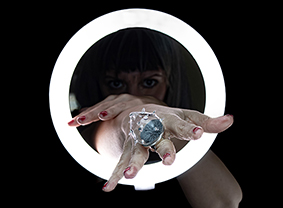
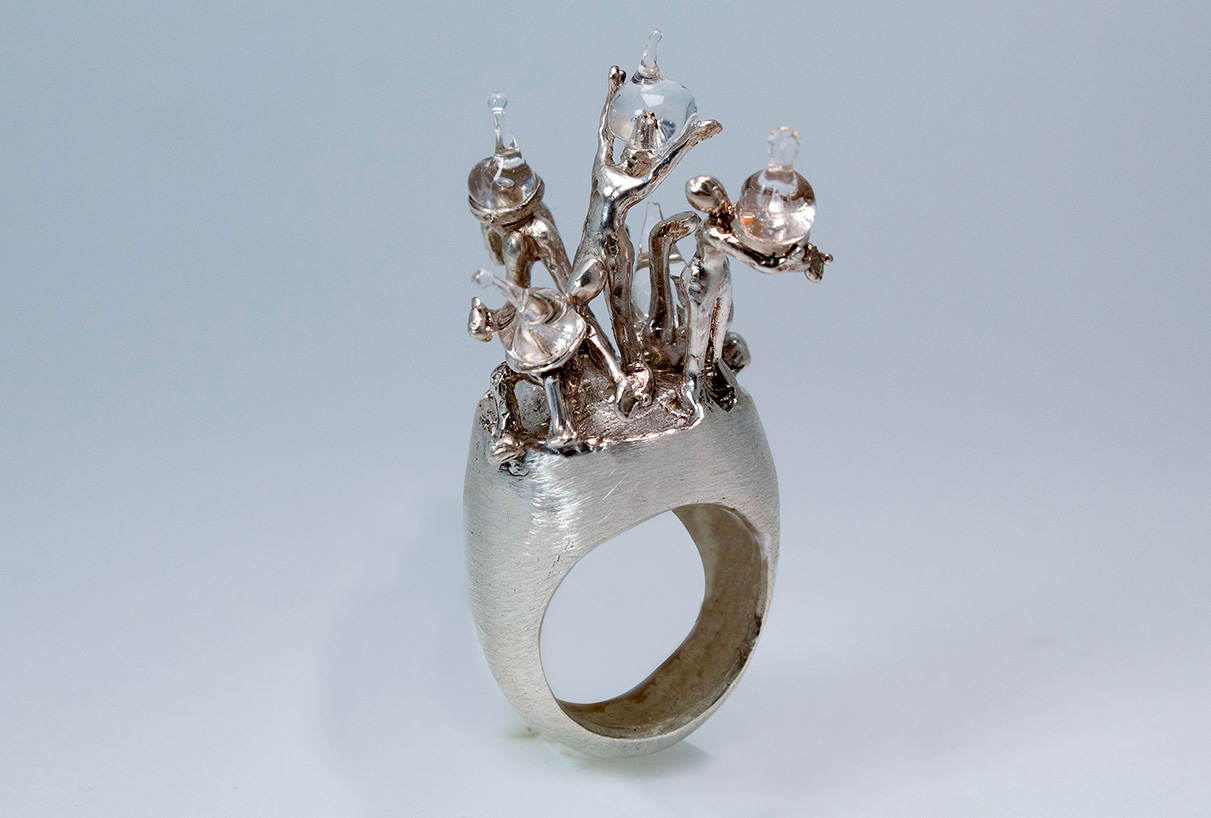
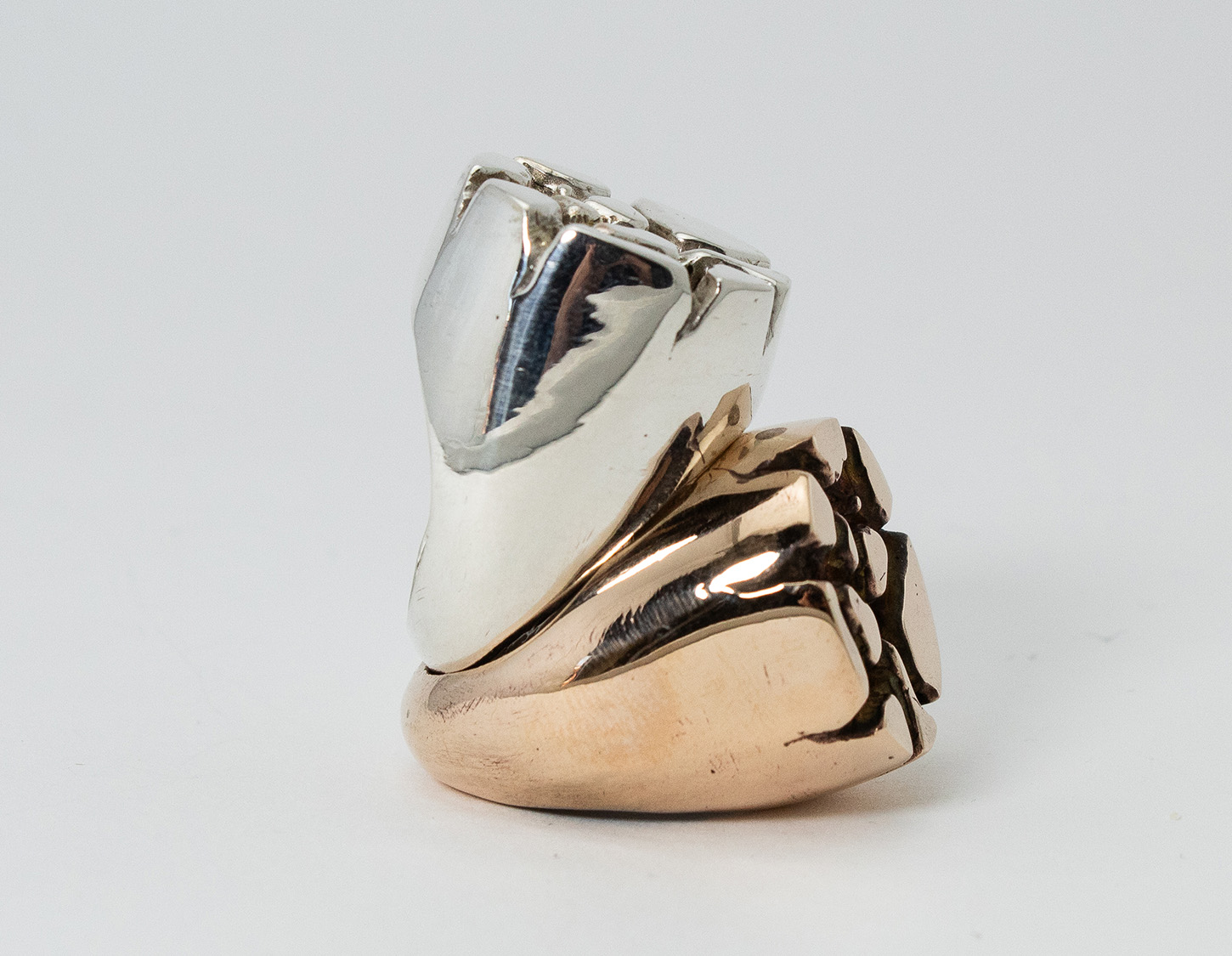
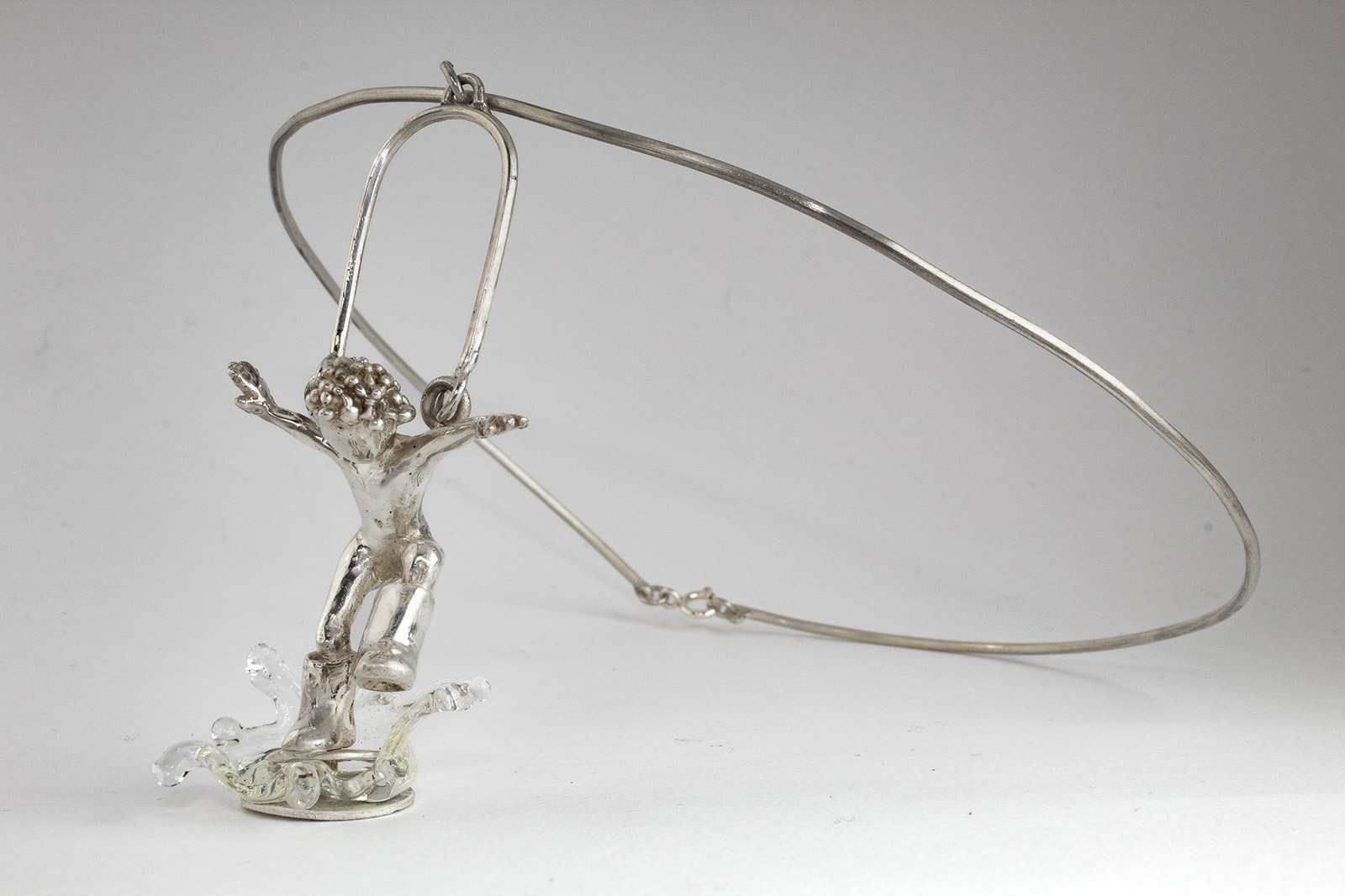
Fabiana Fusco has become one of the most consistent international presences on Romania’s contemporary jewelry scene. Through her many appearances at events across the country, the Rome-based artist has built a loyal community of admirers and collectors whom she reconnects with each time she returns. For Fabiana, Romania has become not only a receptive market, but also a source of encouragement and creative inspiration. We spoke with her about her journey from art history to the jeweler’s bench, socially engaged collections, music, her relationship with the public, and the courage to remain true to her own artistic language.
You studied Art History and wrote your thesis on ancient Greek jewelry before training at Salvatore Gerardi’s School of Goldsmithing. How did you make the transition from art theory to working with your hands and, more specifically, to the jeweler’s bench?
In the beginning, attending the goldsmith school was subordinate to my studies. The initial project was to work in archaeology and restoration of ancient jewelry, but after a few months spent at the bench, the creative part started to be more attractive. So I started to create my first pieces, and at the same time I was part of some university projects, waiting to take the exam to be admitted to Istituto Centrale per il Restauro of Rome. Working at the bench, specifically with lost wax, finally led me to create my first collection, which was inspired by jazz music, and my first exhibition in Rome, meanwhile things at university became difficult and I decided to leave.
After jewelry, you have now moved into a new project, Gentile Obiect. What inspired you to expand your practice beyond jewelry? Did it grow from a need to diversify your portfolio or, rather, from a creative curiosity that needed a new space?
Contemporary jewelry, in my case, represents a way to denounce and to put a light on social topics, on something that is sometimes difficult to face. The 3D accessories and bags are a way to put my creativity into something that doesn’t necessarily have to be so serious, which allows me to be more joyful and to create just for the pleasure of doing it. At the same time, it is also a way to diversify my income and have something that can work when I have to work on a new jewelry collection, which can usually take months.
Alongside your jewelry practice, you are becoming increasingly active as a singer. How do these two forms of expression coexist in your life? Do you feel that they influence or nourish each other?
I live through my passions; feelings and emotions are part of my works. It changed some years ago from contemporary dance to singing, but the necessity to express myself is common; it’s just a different way, so it’s a sort of flow from my soul to my hands, to my voice, and I have to say that doing it also on social media helps my art to be more visible.
In May 2026, you gave a live performance at AUTOR together with Thomas Miskovich, who is also a jewelry artist. How did this collaboration begin, and how do you see it now, several months after your debut in front of the contemporary jewelry community?
We have known each other for about eight years, more or less, and we met during fairs, exhibitions or events. We knew we shared a common passion for music, and we said a lot of times that we had to jam together, but finally Thomas sent me a message in April this year and proposed doing something together… From a shy guy like him, it was a very unexpected proposal! The first and only time that we tried to play together online was a disaster, but somehow it was clear that there would be potential and a good connection between us, and we decided to take a risk and organize the performance for AUTOR. Definitely, it was great, for the connection, the mood and the way it happened so naturally. I hope that our colleagues enjoyed it, especially thinking about the fact that we were able to choose only love songs… the ones that usually make you think of your special person. We need more musicians now to grow the band and find more party songs for the next concert!

Your relationship with the Romanian market
Over several editions, you have been a consistent presence at jewelry events in Romania, including AUTOR, NOËL, and Romanian Jewelry Week. What keeps bringing you back and maintaining your connection with the local market?
Imagine that when I arrived in Bucharest for the first time to exhibit my works, it was a sort of new beginning for me. After a pause, because I became a mum and I was a little bit discouraged by the Italian market’s response to my creations, I decided to apply for foreign selections. The warm welcome and the appreciation for my pieces surprised me a lot and gave me a sort of new chance. There are probably common feelings that capture Romanians in my world, and for sure, here more than ever, I found a real appreciation for handicrafts.
How has your relationship with Romanian audiences and clients evolved since your first participation in 2021? How important has returning consistently been to your development as an artist and to building relationships with your audience? Is the connection different when a client encounters your work year after year, rather than at a single event?
May I say that it was love at first sight? And for sure, the fact that my memory is veeeery good helps. I’m used to remembering every person that I meet and often the piece that they fell in love with… so, being present two, then three, now four times every year allowed me to create real relationships with clients… It became a sort of family, and talking with them and telling them what happens in my creative mind every time creates bonds. People are surprised because they are curious to know what my hands create year by year. They trust in me and give me value; they really don’t just wear my jewelry, they share the stories behind a necklace or a ring as part of their own living experience.
You live in Rome, but Romania — and Bucharest in particular — seems to have become a kind of second home for you. Do you notice any differences between the way your work is received here and how it is perceived in Italy or in other markets where you exhibit?
There are differences! As far as Italy is concerned, to be honest, I’m not so positive. Sometimes, working with contemporary jewelry in my country seems to be related more to pure business and less to art. I feel that abroad, though this is my experience, contemporary jewelry represents part of the art fields, and exhibitions and fairs were organized and led with the aim of helping artists not only to grow but to face each other without competition or envy and to learn from others’ research or visions. A strong community that renews itself year by year and supports the youngest ones. Bucharest is excellent in this respect. Open-minded, ready to experiment and wear new materials, interested in jewelry not only for its preciousness but for what it can tell and symbolize.
The social dimension of your collections
Some of your jewelry and collections address social and political subjects, including Palestine and the Freedom Flotilla. How do you translate such politically and emotionally charged subjects into jewelry that can be worn?
Each of us has to take a position about what happens around us, and I think that one of the aims of every artist is to put a light on it, even if it is a small pin. We have to do our part. Sometimes, a question on a paper boat pin, like the one that I gave as a gift to people last year, can leave a seed and can help people think about it. A brooch or a necklace can be not just a decoration or something that can be a good investment, but also a demonstration of what you think or what you believe in. As an artist, it is a duty for me.
Jewelry is still largely perceived as decoration, an investment, or a symbol of status. Your practice, however, belongs to a direction that argues that jewelry can be much more: it can convey an idea, open up conversations, and become a statement, whether subtle or powerful. What does it mean to work within this more focused area of contemporary jewelry, and how do you protect your artistic voice without moving toward mainstream formulas?
It’s a duty, as I told you. It is my way to live my work, which obviously is not only a job, but is part of my life… a big part, I have to say. Some years ago, I listened to Charon Kransen, the contemporary jewelry curator, who said that artists have to be true to themselves. I’m not going to create things because this kind of jewelry is in fashion at the moment. I follow my inspiration, I’m true to myself because finally, I think, people recognize it and appreciate your coherence, and this is going to reward you in the end.

Selling and the artist’s relationship with the audience
In your experience, what makes a jewelry artist commercially compelling, beyond the quality of the jewelry itself? How important is the artist’s attitude?
The artist’s attitude makes the difference! It is the magic touch; it lets the buyer know that what they are going to buy and wear is going to make them feel different, special, and give them the chance to say that it is something made not only with metal or stones but with soul, with a vision, with something more. It’s as if the object has the power to make them feel like artists too, just because they were able to have it.
What kind of presence do you think is needed when interacting directly with a client at a fair or another type of event? How do you sell a story and an idea, rather than simply an object?
Stand up, smile, don’t be afraid to expose yourself, to confess your feelings and your weaknesses, be yourself, for better or worse. People feel that you are real. Tell your story, tell the story behind your collection, even if the person in front of you is shy or a little bit doubtful. Finally, in most cases, they’re going to stop and listen to you, and even if they don’t buy anything that time, they’re going to remember you and come back sooner or later…
What advice would you give young jewelry artists who struggle to sell their work, either because they are too reserved or because they are too emotionally attached to their pieces to let them go? What is the inner shift that helps an artist move forward, and what kind of attitude can keep them from progressing?
It’s not easy; we are not selling something that is a basic necessity. I have to confess that, since the first pieces that I made, I was used to keeping the very first piece for myself, like Donald Duck’s uncle and his Number One Dime. They were not for sale; I just sold the second one… Nowadays, it is different. If there is a piece that has a special bond with me, it becomes the one that I wear during the exhibition or the fair, so I don’t have to sell it. By the way, the contemporary jewelry field is very strange. Some years you have a good collection and it doesn’t sell, even if you are sure of your work; some years it is the opposite. You have to be strong, not discouraged, follow your way, listen to the advice of older artists but be very confident in yourself, and work to create a part of the collection that can be more affordable but not far from the main one, just something that gives you the chance to earn money and gives people the chance to go home with something, even if they can’t afford a unique piece. Finally, they can have one of your pieces!
We will soon meet again at AUTOR Cluj Edition, on October 10 and 11. This will be your second participation and another opportunity to connect with the audience in Cluj-Napoca. How would you describe this audience, which came out last year to discover the artists presented at the city’s first fair dedicated exclusively to contemporary jewelry?
Last year, I decided to join the Cluj Edition just because I wanted to visit Transylvania… NOOOO, I’m kidding! Last year was a challenge: to take part, discover a new market, educate a new public and support a new team that tries to open new possibilities. The audience was surprised, interested and curious. They asked for explanations; they wanted to know about techniques and how long it takes to make a piece… so I hope that this year we are going to find people who, having been guided by curiosity since the first edition, will be more involved, have deepened their knowledge and want to see more. I’m ready to turn on the lights and answer their curiosity!